The Jewish community of Thessaloniki: history, synagogues, museums and what to see
The complete guide to Jewish Thessaloniki: how it became the "Jerusalem of the Balkans", what happened in the Holocaust, and what to see today – the Jewish Museum, the Monastirioton synagogue, the Holocaust memorial and the Holocaust Museum under construction. Plus Chabad, kosher food and visiting tips.
- From 1492 Thessaloniki was a centre of Sephardic Jewry; in 1613 Jews made up 68% of its population.
- In 1943 about 50,000 Jews were deported from the city to Auschwitz; more than 90% were murdered. About 1,200 Jews live there today.
- The Jewish Museum is open Sunday to Friday (closed Saturday). The Holocaust Museum of Greece is under construction, due for completion in 2028.
Visiting Thessaloniki? Give half a day to the Jewish route: the museum, Monastirioton and Eleftherias Square. Come on a weekday and bring your passport.
In brief
For centuries Thessaloniki was one of the world's most important Jewish cities, known as the "Jerusalem of the Balkans". Ladino was the everyday language of most of its Jews. In the Holocaust almost the entire community was murdered. Today the city has a small, active community, a Jewish museum, synagogues and Chabad, and a national Holocaust museum is under construction.
The history of Thessaloniki's Jews
Before the expulsion from Spain. Jews lived in Thessaloniki in antiquity. The Book of Acts mentions a synagogue in the city, and the old community was Romaniote, Greek-speaking.
1492: the Sephardim arrive. After the expulsion from Spain, waves of exiles reached the city, then under Ottoman rule. A census of 1519 counted about 16,500 Jews, and the 16th century is seen as the community's golden age. Congregations organised by country of origin, each with its own synagogue.
A Jewish-majority city. In 1613 Jews made up about 68% of the population. They dominated whole trades, including wool, and Sultan Selim II made the Jews of Salonica the sole makers of uniforms for the Janissaries. The community's language was Ladino (Judeo-Spanish).
1917: the Great Fire. The fire that destroyed the city centre burned the seat of the Chief Rabbinate and its archives, and 16 of 33 synagogues. About 52,000 Jews were left homeless.
The Holocaust. On 11 July 1942, "Black Sabbath", all Jewish men aged 18 to 45 were rounded up in Eleftherias (Liberty) Square and publicly humiliated. In February 1943 Nazi deportation specialists arrived. The first train left for Auschwitz on 15 March 1943, and by the end of May about 50,000 Jews had been deported. More than 90% of the city's Jews were murdered. The vast Jewish cemetery, with 300,000 to 500,000 graves, was destroyed; Aristotle University stands on its site today.
Today. About 1,200 to 1,300 Jews live in the city – Greece's second-largest community after Athens. Community institutions are in the city centre.
What to see: the Jewish route in Thessaloniki
The Jewish Museum of Thessaloniki
The museum stands at the corner of Venizelou and Agiou Mina (Agiou Mina 11), in a community building from 1904 – one of the few in the centre to survive the 1917 fire. It opened in 2001. The ground floor shows tombstones from the destroyed Jewish cemetery. Upstairs is the permanent exhibition "Thessaloniki, Metropolis of the Sephardim", telling the community's story and the Holocaust, plus a section on the Jewish communities of northern Greece.
According to the city's tourism site (thessaloniki.travel):
| Mon, Tue, Thu, Fri | 9:00–14:00 |
| Wednesday | 9:00–14:00 and 17:00–20:00 |
| Sunday | 10:00–14:00 |
| Saturday | Closed |
| Entry | €8, students €3 |
Check the museum's website, jmth.gr, before you go.
The Monastirioton synagogue
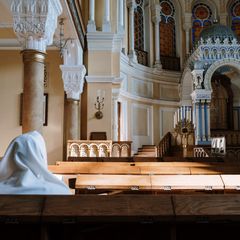
The Monastirioton synagogue, at Syngrou 35, was built in 1925–1927 by Jews from Monastir (today Bitola in North Macedonia). The main donation came from Ida Aroesti in memory of her husband Isaac. During the Second World War it survived because the Red Cross used it, making it one of the very few synagogues in the city to survive the war. Damaged in the 1978 earthquake, it was restored, and a major restoration was completed in 2016.
Note: it is no longer used for daily prayer. Services are held on holidays, especially the High Holidays. Arrange a visit in advance with the Jewish Community of Thessaloniki (jct.gr).
Yad Lezikaron synagogue
Yad Lezikaron synagogue, at Vasileos Irakleiou 24, was inaugurated in 1984 in memory of the Holocaust victims. It stands on the site of a small 1921 synagogue known as "Cal de la Plaza" (the market synagogue), which served Jews working in the nearby market. According to the city's tourism site it is currently closed to visitors.
The Holocaust Memorial in Eleftherias Square
In Eleftherias Square, exactly where the Nazis gathered the Jewish men in July 1942, stands the Holocaust Memorial of 1997: a seven-branched menorah and flames formed from human bodies, by sculptor Nandor Glid.
The Holocaust Museum of Greece (under construction)
The Holocaust Museum of Greece will be built in Thessaloniki on the site of the old railway station, from where the deportation trains left. The construction contract was signed on 30 January 2026 and building is expected to take about two years, so opening is expected in 2028. It is funded by the Greek government, Germany, the Stavros Niarchos Foundation and other foundations. It cannot be visited yet.
Chabad and kosher food in Thessaloniki
- Chabad of Thessaloniki: Salaminos 9. Daily and Shabbat prayers, a mikvah, and Shabbat and holiday meals by registration on jewishthessaloniki.com. WhatsApp: +30 693 986 5991.
- The kosher Hashalom restaurant is at the same address, with meat and dairy catering for delivery.
- Shabbat times in Thessaloniki: Shabbat times & kosher in Greece.
More Chabad houses: Chabad in Greece. All kosher restaurants: kosher food in Greece.
Tips for visiting Jewish Thessaloniki
- Come on a weekday. The museum is closed on Saturday and the synagogues have no regular visiting hours.
- Arrange synagogue visits with the Jewish Community of Thessaloniki in advance, and bring your passport.
- A half-day route: the Jewish Museum, Monastirioton and Eleftherias Square are all in the city centre.
- Combine it: Thessaloniki is a handy base for Chalkidiki. More on the city: Thessaloniki travel guide.
- Flights: there are direct flights from Tel Aviv, and a route from Haifa is due to open. Details in our flights to Thessaloniki guide.
FAQ
How many Jews live in Thessaloniki today?
About 1,200 to 1,300 – Greece's second-largest Jewish community after Athens.
Why is Thessaloniki called the "Jerusalem of the Balkans"?
Because for centuries it had a Jewish majority. In 1613 Jews were about 68% of the population, and most of its Jews spoke Ladino.
When is the Jewish Museum of Thessaloniki open?
According to the city's tourism site: Mon, Tue, Thu and Fri 9:00–14:00, Wednesday also 17:00–20:00, Sunday 10:00–14:00. Closed on Saturday. Entry €8.
Can I visit the Monastirioton synagogue?
Arrange it in advance with the Jewish Community of Thessaloniki. The synagogue is not used daily; services are held on holidays, mainly the High Holidays.
Is the Holocaust Museum in Thessaloniki open?
No. The construction contract was signed in January 2026 and opening is expected in 2028. It will stand by the old railway station.
What happened to the Jews of Thessaloniki in the Holocaust?
In 1943 about 50,000 Jews were deported from Thessaloniki to Auschwitz, on trains starting from 15 March. More than 90% of the city's Jews were murdered.
Is there Chabad in Thessaloniki?
Yes, at Salaminos 9, with prayers, a mikvah, Shabbat meals by registration and the kosher Hashalom restaurant.
Where was the Jewish cemetery of Thessaloniki?
On the site where Aristotle University stands today. The cemetery was destroyed during the war, and the Jewish Museum displays tombstones saved from it.
Details checked against official sources and Wikipedia on 4 October 2026. Opening hours and visiting arrangements can change, so check before you go. More background: Jewish history of Thessaloniki.